AI Labs Are Buying the Last Mile. Talent May Be the Real Moat.
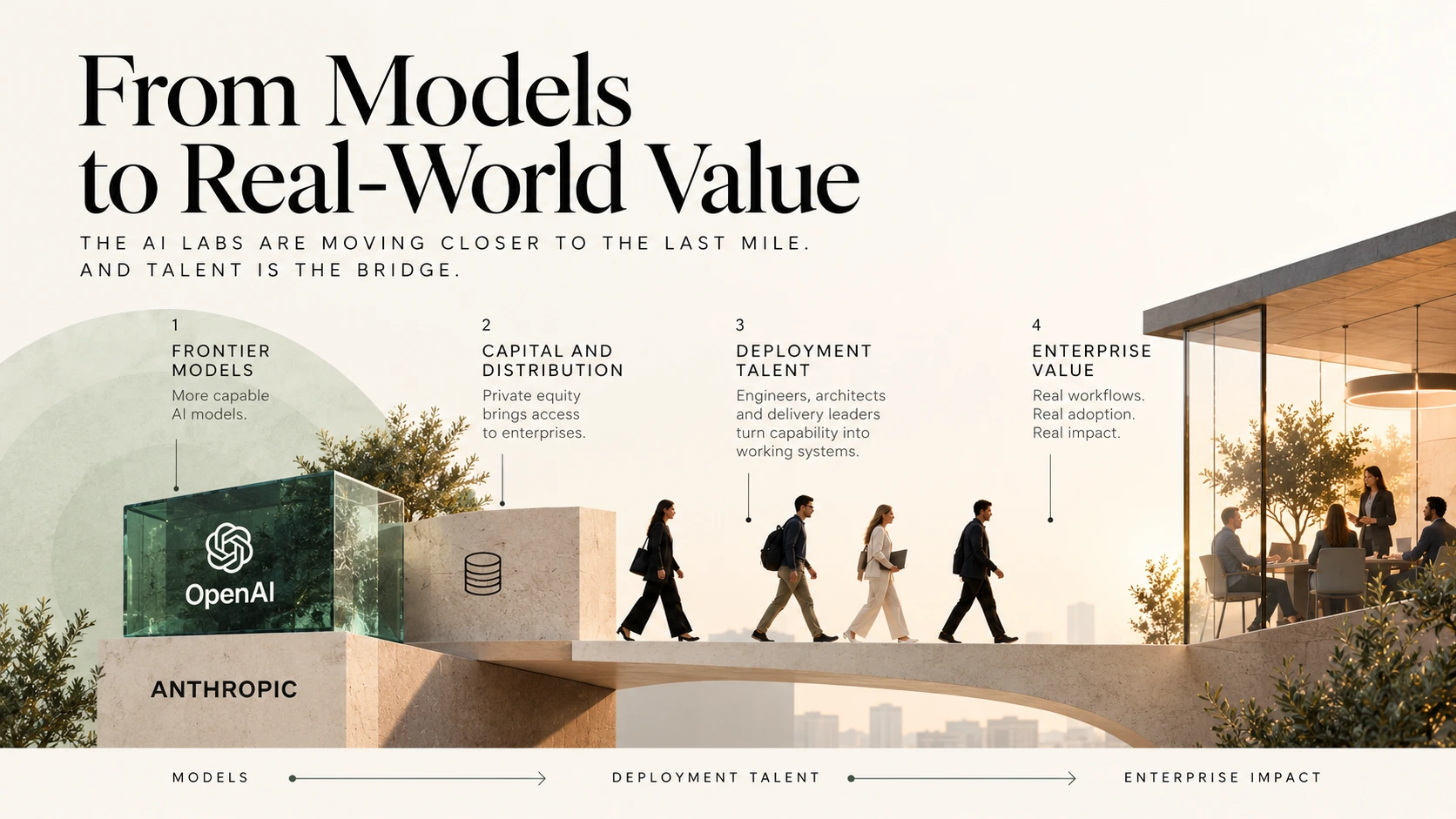
If you want to understand where enterprise AI is going, don't just watch the models. Watch who the AI labs are hiring and acquiring.
Over the past year, some of the biggest AI companies have moved much closer to the work that happens after a model is built: finding where it creates value inside an enterprise, integrating it into real workflows, and getting people to actually use it.
OpenAI launched the OpenAI Deployment Company with a group of investment, consulting and systems integration partners led by TPG, with Advent, Bain Capital and Brookfield as co-leads. Anthropic took a similar path, partnering with Blackstone, Hellman & Friedman and Goldman Sachs on a new AI services company designed to bring Claude into the core operations of private equity–backed businesses.
Most of the coverage has focused on what these moves mean for consulting firms. I see something else.
I spend my days recruiting the people who make enterprise AI work, and from that seat, these moves say as much about the talent market as they do about the consulting market.
The last mile is becoming part of the product
For the last few years, enterprise AI had a fairly clear division of labor. The labs built the models, consulting firms and systems integrators helped companies figure out what to do with them, and architects, engineers and delivery teams did the messy work of putting it all into production.
Those lines are starting to blur. The labs aren't replacing the consulting ecosystem; traditional firms are partnering with them and, in some cases, investing alongside them. But the labs are clearly moving closer to the point where technology becomes business value.
That makes sense. A powerful model doesn't create much value sitting behind an API. Someone still has to understand the workflow, connect the technology to enterprise data and systems, navigate security and governance, earn the trust of the people expected to use it, and make it work in production.
That last mile is becoming strategic, and apparently valuable enough to buy.
Follow the talent
This is the part I find most interesting. OpenAI could have built its deployment organization one hire at a time. Instead, it agreed to acquire Tomoro, an applied AI consulting firm, and bring roughly 150 experienced forward deployed engineers and deployment specialists into the business on day one.
Think about what that signals. Enterprise AI needs people who can operate between the technology and the business, and building that bench organically may not be fast enough.
I see the scarcity firsthand. Finding a strong engineer isn't necessarily the hardest search. The hard search is for someone who is technically credible, understands how an enterprise actually runs, can challenge a client without losing them, can turn an ambiguous business problem into something a team can build, and still wants to stay close enough to the work to deliver it.
That pool gets small very quickly.
The titles vary: forward deployed engineer, AI architect, principal engineer, AI strategist, engagement lead, solution architect. The common denominator is harder to capture in a job description, and it's becoming incredibly valuable: technical depth, judgment and the ability to operate with a client.
Private equity changes the equation
The private equity piece matters for another reason. It isn't just capital; it's distribution. These firms bring access to large networks of portfolio companies across healthcare, manufacturing, financial services, logistics and more.
Put those pieces together and the advantage starts to compound. The labs bring the models, investors open doors to enterprises, and deployment teams learn where AI actually works, where it breaks and what companies are willing to pay for. That knowledge carries into the next deployment.
The more enterprise AI moves in this direction, the more valuable the people in the middle become. That's why I think talent may become part of the moat.
The consulting model may change with it
There are broader workforce implications too. The traditional consulting pyramid may start to look more like a diamond. As AI absorbs more research, analysis and production work, firms may need fewer people focused on junior execution and more experienced practitioners who can frame problems, exercise judgment and work directly with clients.
But the part I'm more interested in is what happens to the roles themselves. The line between consultant and engineer is already blurring, and I'm seeing jobs emerge that don't fit neatly into either category. Some are highly technical, others lean toward strategy and client leadership, and the most interesting ones sit somewhere in between.
AI will also put pressure on the billable hour. If technology sharply compresses the labor needed to deliver an outcome, firms will have to rethink how they price the value they create.
And there's a workforce problem underneath all of this that I don't think we've solved. If AI takes on the work junior employees have always learned through, like research, analysis, documentation and first drafts, how do we develop the senior people we'll need five or ten years from now?
I keep coming back to that question, because it's not just a consulting problem. Every function will face some version of it.
What I'm watching next
The takeaway isn't that AI labs are suddenly consulting firms and Accenture should panic. The more interesting shift is that the boundaries between model companies, consulting firms, systems integrators and enterprise technology teams are getting harder to see.
Building better models is only part of the race. Inside the enterprise, another race is forming: who can turn those capabilities into systems people actually use, and who has the talent to do it again and again at scale.
When one of the most important AI companies chooses to acquire a seasoned team of forward deployed engineers rather than build that bench one hire at a time, that's worth paying attention to. The next competitive advantage in enterprise AI may not be another model benchmark.
It may be the people who know what to do with the models once they walk through the client's door.
Coming next: The jobs that don't exist yet. As AI reshapes consulting and enterprise delivery, I think entirely new roles will emerge between engineering, strategy, product and the business. In my next post, I'll look five to ten years ahead at what some of those jobs could be, and what today's talent market may already be telling us about them.
Sources: OpenAI · The Next Web · Yahoo Finance